
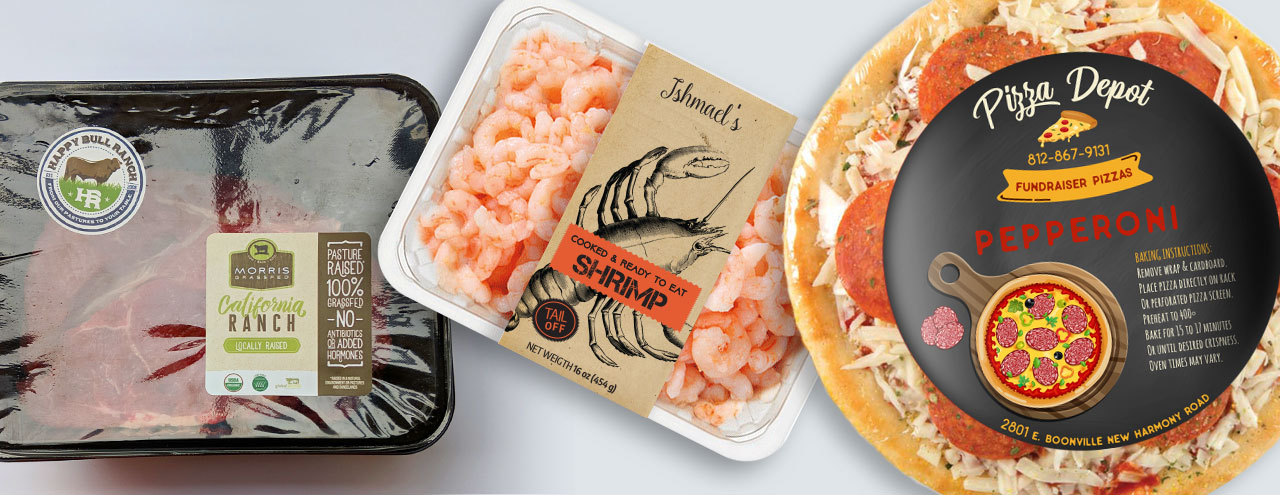
Freezer labels are required when a product moves through the cold chain, where condensation, low temperatures and the packaging surface itself can cause ordinary labels to lift, wrinkle or become unreadable. The product category matters less than the combination of packaging material, application temperature and how long the label has to stay legible.
This guide covers the frozen product categories where freezer-grade labels are the right specification, the failure mode driving each choice and how to match the label to the application, not the other way around.
When does a product need a freezer label?
Products don’t need freezer labels because they’re classified as frozen food. They need them because the packaging surface, the application moment and the cold-chain conditions together exceed what a standard label was built to handle.
A standard pressure-sensitive label fails in the freezer for one of three reasons: the adhesive doesn’t bond at low application temperatures, the facestock can’t tolerate the moisture cycle or the packaging surface was the wrong match from the start.
A freezer-grade label is the right call when any of the following apply:
Common products that need freezer labels
The categories below cover the bulk of frozen product applications. The challenge isn’t usually the freezer itself; it’s the packaging substrate and the moment the label gets applied to it.
Frozen meat and poultry
Vacuum-packed meat is labeled in motion, often before it enters cold storage. The label has to bond to a chilled polyethylene film that’s still settling into shape under vacuum pressure, then hold through condensation cycles as the case travels from production to the retail counter. Edge lifting can affect presentation, barcode readability and product identification, making it an issue many manufacturers work to avoid.
For applications across fresh, ground and processed cuts, see our meat labels.
Frozen seafood
Seafood packaging endures harsher moisture conditions than almost any other frozen category. Vacuum pouches sit in direct contact with ice, flexible bags are filled hot or cold depending on the product and rigid containers move through brine spray during processing. Adhesives selected for lower-moisture frozen applications may not provide the same performance in seafood packaging.
A specification that holds through extended cold-chain transit is the standard found in our seafood labels range.
Ice cream and frozen desserts
Ice cream is the temperature-cycling category. Containers leave the hardening tunnel cold, sit in distribution centers cold and then face daily warm-air intrusion every time a retail freezer door opens. Frequent temperature fluctuations expose the label to repeated condensation throughout distribution and retail display. Curved tub geometry compounds the problem: adhesives have to resist both the temperature swing and the slight flex of the substrate.
Tubs, pints, gelato cups, frozen yogurt and novelty packs all share this failure profile. Our ice cream labels are built around it.
Frozen ready meals
Ready meals are the mixed-substrate category. A single SKU often combines a CPET or polypropylene tray, a film lid, a paperboard sleeve and sometimes a secondary carton. The label has to hold up across whichever surface it lands on. A label can adhere perfectly to the paperboard sleeve while lifting on the polypropylene tray in the same product family. The complication isn’t temperature; it’s that production lines rarely change adhesive between SKUs, so one specification has to perform on all of them.
Frozen bakery products
Frozen dough, par-baked bread, pastries and laminated bakery items are typically packed warm from production and dropped immediately into blast freezers. The label is applied near ambient temperature and has to survive a 60 to 80°F swing within minutes. Bakery films are also frequently dusted with flour residue, which is one of the more underrated adhesion killers in the freezer aisle.
Frozen fruits and vegetables
Frozen produce is dominated by flexible plastic bag formats, which condense aggressively during fill, freeze and transport. In many frozen produce applications, the label primarily supports product identification, inventory control and barcode scanning rather than branding. A label that smears or lifts can create scanning and inventory issues throughout distribution.
Frozen pet food
Raw and frozen pet food is the fastest-growing freezer category by SKU count, and it presents the same adhesion problem as frozen meat with an added twist: the packaging is almost always a flexible pouch with very little surface tension. Cold film flex, repeated handling through specialty retail and direct-to-consumer fulfillment and increasingly small batch sizes all push the label specification harder than the storage temperature would suggest.
See our frozen pet food labels for applications in this category.
Choosing the right label for frozen products
Three variables decide whether a label survives the freezer:
Storage temperature alone is the least useful variable. The application moment is what most often determines whether a label is still legible six months later.
Different frozen products create different labeling challenges because packaging materials and production environments vary widely. The table below summarizes the most common application differences.
| Product category | Typical packaging | Primary challenge |
|---|---|---|
| Meat and poultry | Vacuum pouches, trays | Bonding to cold polyethylene film |
| Seafood | Flexible bags, rigid containers | Direct ice and moisture contact |
| Ice cream | Paper tubs, plastic cups | Temperature cycling and condensation |
| Ready meals | Trays, films, sleeves | Mixed substrates on one SKU |
| Bakery | Flexible film, cartons | Cold application after warm pack |
| Frozen produce | Polyethylene bags | Condensation, scan legibility |
| Pet food | Flexible pouches | Low-tension film, handling |
Frequently asked questions
Can you apply a label directly to a frozen product?
Yes, with the right adhesive. Cold-temperature adhesives are formulated to bond at sub-freezing application temperatures, but the working window is narrow. Adhesive system, packaging surface, application speed and dwell time all matter. Most production lines get better results applying before the product enters the freezer.
Are freezer labels different from refrigerator labels?
Yes. Refrigerator applications stay above freezing, so condensation is the main challenge and standard pressure-sensitive adhesives often perform adequately. Freezer applications add cold-temperature adhesion, freeze-thaw cycling and substrate flex, which is why a freezer-grade specification isn’t optional below 32°F.
What’s the most common reason a freezer label fails?
Application conditions, not storage. The label was applied to the wrong substrate, at the wrong temperature or with the wrong adhesive for either. Freezer storage itself is rarely the variable that pushes a properly specified label past its limit.
Match the label to the application
If you’re specifying labels for a frozen product, the freezer labels category covers the full range.
Request a free quote today and secure custom labels that match the quality and integrity of your products.